

Watches, art, cars, jewelry, handbags, wine and more — cleaned, USD-normalized, and searchable.
Get Started →
THE SOUTH ASIA EDIT AT SOTHEBY’S
Six Distinct Voices in the Story of Modern & Contemporary South Asian Art Revealed
Through Rarely Seen Works from Estates, Private Collections and Institutions
On View in Sotheby’s London Galleries from 13 July to 7 August
LONDON, 29 JUNE 2026 – This July and August, Sotheby’s presents The South Asia Edit, a series of exhibitions celebrating six distinct voices in the history of South Asian modern and contemporary art. Rather than proposing a singular narrative, the project showcases the artistic achievement of each artist through a series of focused presentations dedicated to Francis Newton Souza, Mohan Samant, Bhupen Khakhar, Zarina, Zahoor ul Akhlaq and Sheherezade Alam.
At the core of The South Asia Edit – on view in Sotheby’s London galleries from 13 July to 7 August – are exceptional and rarely seen groups of works drawn from defining moments within each artist’s oeuvre. The project includes a focused presentation of works by Francis Newton Souza from the Alkazi Collection of Art, exploring the artist’s enduring engagement with Christian imagery. Also featured are Samant’s celebrated Music & Dance series; Khakhar’s experimental printmaking of the 1990s and early 2000s, presented alongside a rare 1988 canvas; and Zarina’s mature gold leaf works, anchored by a monumental marble tasbih. Completing the project is a rare presentation that pairs Akhlaq’s contemplative canvases with Alam’s timeless ceramic vessels. Together, these exhibitions offer an opportunity to encounter each artist through a distinctive body of work that showcases the depth and range of their artistic production.
While their practices span painting, printmaking, sculpture and ceramics, these artists are united less by style than by a shared spirit of experimentation. Their careers unfolded across Bombay, Baroda, Aligarh, Lahore, London, Paris, New York and beyond, reflecting the cosmopolitan artistic networks that shaped modernism in South Asia and its diaspora. Drawing on influences as varied as Christian iconography, European modernism, Urdu calligraphy, miniature painting, music, geometry and British Pop Art, they articulated highly individual responses to questions of form, memory, identity and representation.
The artists featured in The South Asia Edit occupy a special place within Sotheby’s history. Through a series of landmark sales, exhibitions and institutional placements, Sotheby’s has played a leading role in advancing international recognition for Francis Newton Souza, Bhupen Khakhar, Mohan Samant and Zarina, and today holds auction records for all four artists. This project echoes that continued commitment to presenting rigorous and scholarly examinations of artists whose significance extends well beyond the market.
The presentation of Francis Newton Souza is drawn from the Alkazi Collection of Art, one of the most important collections of the artist’s work, and of modern Indian art more broadly. The exhibition brings together a select group of paintings that have remained largely unseen since entering the collection and serves as a curtain raiser to a broader exploration of the Alkazi Collection in the years to come.
In the same spirit, Sotheby’s is partnering with Jhaveri Contemporary on the dual presentation of artist couple, Akhlaq and Alam. They first met in London in the summer of 1968 and this exhibition reunites their work in the city nearly sixty years later. A rare opportunity to see these artists’ diverging approaches side-by-side, this presentation celebrates two important figures in the history of Pakistani modern art.
Taken together, these exhibitions offer a series of encounters with some of the most compelling artistic practices to emerge from South Asia in the twentieth century, highlighting the nuance, ambition and continued relevance of their work today.
Manjari Sihare Sutin, Worldwide Head, Indian and South Asian Art, said: “These exhibitions are rooted in years of conversations with artists’ estates, private collectors and institutions, and reflect the kind of long-term stewardship that has defined Sotheby’s engagement with South Asian art. Much of the material presented has remained in the care of these collections for decades and has rarely been exhibited publicly, offering audiences an opportunity to encounter extraordinary works that have largely remained out of view. The South Asia Edit demonstrates the role Sotheby’s can play in bringing together scholarship, private sales and curatorial programming to deepen public engagement with artists who continue to shape the history of global modern and contemporary art. What excites me most is the opportunity to present exceptional groups of works that illuminate defining moments within each artist’s practice, creating new points of access for audiences and collectors alike.”
FRANCIS NEWTON SOUZA
This focused exhibition of works from the Alkazi Collection of Art examines Francis Newton Souza’s lifelong engagement with Christian imagery, a subject that produced some of the most powerful and psychologically charged works of the artist’s career.
At the centre of the presentation is Crucifixion (1984, illustrated left), an altarpiece-scale painting in which Souza depicts himself offering Communion beneath the Cross, collapsing the Last Supper, the Crucifixion and the Eucharist into a single image of ritual, sacrifice and self-identification. Seen alongside the seminal Three-Headed Christ (1950, illustrated below) and other key works, the exhibition reveals how the imagery of Christ, the Church and the sacred body remained a constant source of inspiration throughout Souza’s life, while continually evolving in form, meaning and psychological complexity.
The exhibition draws on the collection of Ebrahim Alkazi, one of India’s most influential cultural figures and a uniquely important custodian of Souza’s legacy. Their friendship spanned decades and was marked by a profound intellectual and personal affinity. As Amal Allana has observed, Alkazi became “if not the keeper of the painter’s soul, at least his spiritual alter ego.” Together, these works offer a rare insight into Souza’s artistic imagination and serve as a curtain raiser to a broader exploration of the Alkazi Collection’s remarkable holdings of the artist’s work in the years to come.
MOHAN SAMANT
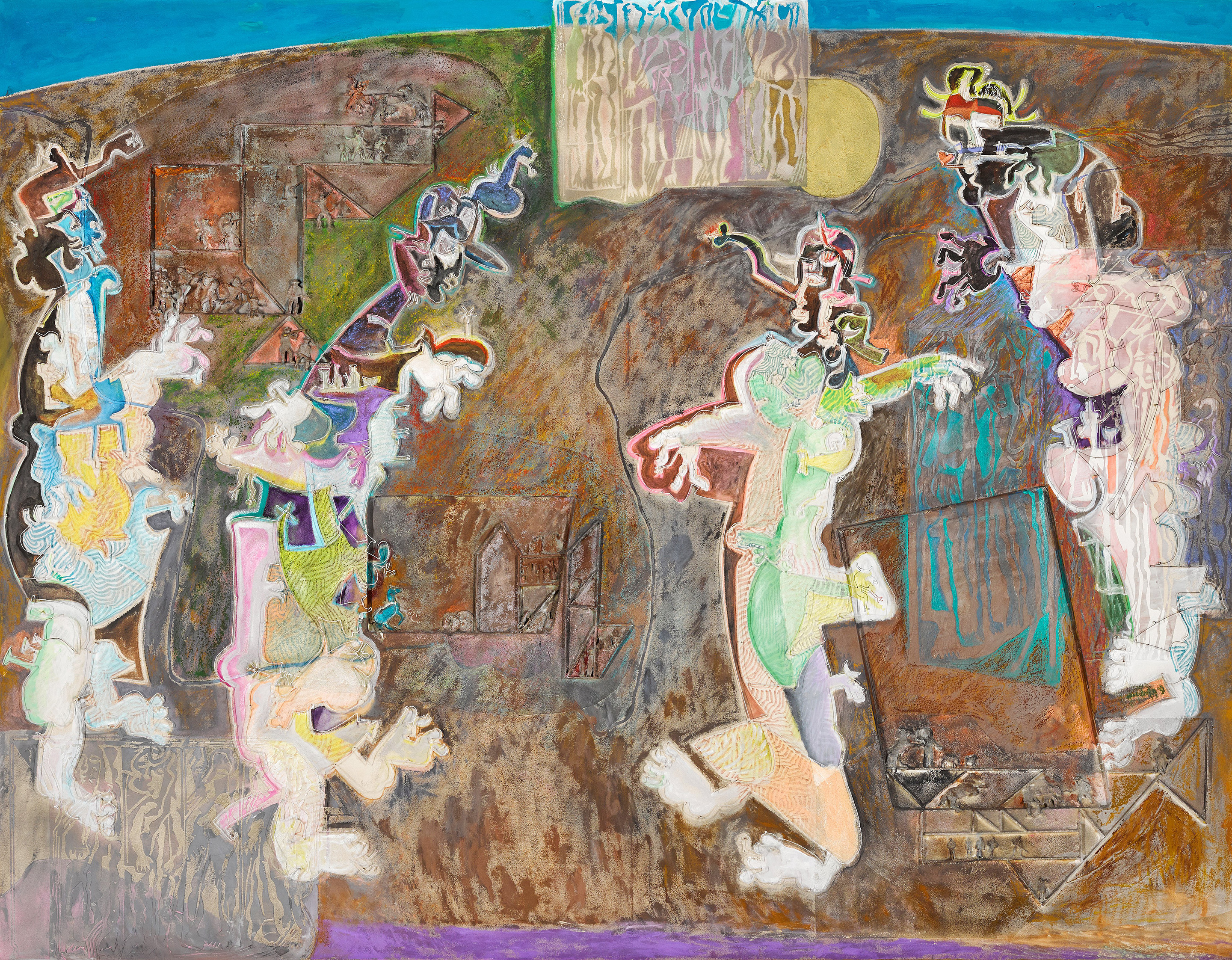
Celestial bodies, musicians, dancers, snake charmers and gods populate Samant’s richly inventive universe. The works presented here belong to the artist’s seminal Music & Dance series.
Bringing together Samant’s lifelong devotion to music and painting, Music & Dance works stand among the defining achievements of his career. Executed between the late 1970s and early 2000s, the series represents the fullest expression of the qualities for which he is most celebrated: rhythmic composition, inventive material experimentation and a uniquely theatrical imagination. Retained by the artist during his lifetime and preserved by his estate following his death in 2004, the paintings presented here have remained together for more than two decades, offering an unusually complete view of a body of work central to Samant’s artistic legacy and a rare opportunity to experience them together.
Drawing on personal experience, mythology and performance, the Music & Dance series reveals the breadth of Samant’s creative vision. His lifelong devotion to the sarangi finds expression in Sarangi Nawaz (2002, illustrated right), where a lone, spectral musician evokes the resonant sound of the artist’s beloved instrument. The monumental Dancing Angels (1988, illustrated above) exemplifies the layered worlds that became a hallmark of Samant’s mature practice.
Despite his early association with the Bombay Progressives and three decades spent in New York, Samant remained wholly distinct from his contemporaries. The works featured in this exhibition are a testament to the originality of his vision and to the quality that led art critic Ranjit Hoskote to describe him as “a one-man avant-garde.”
BHUPEN KHAKHAR
A selection of works from the Estate of Bhupen Khakhar – traversing prints, ceramics and sketchbooks – highlights the range of an artist whose curiosity continually extended beyond the canvas. Together, these works reveal a practice shaped by invention, travel and an enduring openness to new forms of expression.
Anchoring the exhibition is a remarkable canvas from 1988, a prized work from the artist’s personal collection. The canvas depicts two nude men in a tender embrace within a secluded landscape (illustrated left). More intimate than overtly erotic, the composition recalls the emotional tenor of Khakhar’s celebrated Seva (1987) while continuing the artist’s reflections on desire, vulnerability and the experience of living between disclosure and concealment.
While best known as a painter, Khakhar was also an accomplished printmaker. His engagement with the medium developed in part through his friendship with P. D. Dhumal, Head of Printmaking at the Faculty of Fine Arts, Baroda. From the late 1980s onward, he embraced etching, lithography, serigraphy and relief printing with characteristic wit and freedom, translating familiar subjects and characters into new forms. A particular highlight is the complete set of woodcuts and linocuts created for Salman Rushdie’s Two Stories, bringing together Khakhar’s illustrations for The Free Radio and The Prophet’s Hair (illustrated above).
The South Asia Edit amasses this large body of work for the first time ever, igniting the conversation around Khakhar’s expansive use of medium. Collectively, these works present an artist of exceptional freedom and versatility, whose practice continually resisted categorization and whose influence remains as vital today as ever.
ZARINA
Following the success of Sotheby’s dedicated Zarina exhibition at the new Breuer building at Sotheby’s New York in March 2026, this presentation brings together works from a range of private collections that reveal the artist’s enduring engagement with materiality, memory and spirituality. Anchored by a monumental marble Tasbih (2012), and complemented by works incorporating gold leaf, crushed tissue, sumi ink and obsidian, the exhibition features the refined visual language that defined her later years.
Among the central themes of these works are darkness, light and the night sky. In compositions such as Tied to the Sky (2017) and Thirty Birds Flying on the Dark Sky (2017, illustrated left), Zarina transformed stars, constellations and celestial forms into meditations on belonging, transcendence and the passage between earthly and spiritual realms. The contrast between black grounds and luminous gold leaf reflects her engagement with the concept of noor (divine light), a subject that emerged in her practice from the 2000s onward.
A set of four woodcuts collaged with gold leaf and thread A particular highlight of the exhibition is Tasbih (2012, illustrated right) made from luminous black marble. Among the most significant sculptural works of Zarina’s later career, the tasbih transforms a familiar devotional object into a monumental meditation on touch, repetition and prayer. Together, the works in this exhibition reveal the depth and clarity of an artist whose exploration of material, form and spirituality continues to resonate far beyond the boundaries of medium or geography.
ZAHOOR UL AKHLAQ
This exhibition brings together works from the estate of the artist, ranging from rare early examples to large-scale canvases of the 1990s. Seen together, they trace the evolution of an artist who transformed the visual language of Pakistani art, forging a distinctive synthesis between South Asian artistic traditions and international modernism.
Employing the grid as both structure and metaphor, Akhlaq drew on the forms of Islamic calligraphy, architecture and Mughal miniature painting while engaging with Cubism and Colour Field painting. In works such as Radio Photo of Objects Unidentified (1983, illustrated left) and Untitled (1991, illustrated below), fragments of image and architecture are layered into complex compositions that move between abstraction and representation, inviting multiple readings while resisting fixed interpretation.
Alongside his own practice, Akhlaq played a defining role in shaping future generations of artists through nearly three decades of teaching at Lahore’s National College of Arts. Instrumental in the development of the institution’s Miniature Painting programme, he established a framework that would profoundly influence artists including Rashid Rana, Shahzia Sikander and Imran Qureshi. Both as an artist and educator, Akhlaq helped redefine the possibilities of contemporary art in Pakistan, establishing a legacy that continues to resonate today.
SHEHEREZADE ALAM
This exhibition brings together thirty-two ceramics from Alam’s later practice of the 1990s. Working across dishes, vases, matka pots and urali bowls, Alam reimagined traditional forms through a distinctly contemporary lens, creating vessels that are at once timeless and deeply personal. These exceptional works from the estate of the artist reveal the potter’s mastery of both the wheel and the firing process.
For Alam, clay was more than a medium; it was a living material capable of transformation. Drawn to the histories of Islamic ceramics and the wider traditions of South Asian craftsmanship, she continually experimented with metallic lustres, speckled glazes and fluted rims. The works presented here reveal an artist of remarkable technical skill, whose sensitivity to form, surface and proportion transformed functional objects into sculptural works of enduring beauty.
Viewed together, these vessels offer insight into a practice rooted in both innovation and inheritance. Through her contemporary reinterpretation of ancestral forms, Alam renewed the expressive possibilities of one of humanity’s oldest artistic traditions, establishing a body of work that remains among the most distinctive achievements in modern South Asian ceramics.
(Press Release)