

ALT/FNDATA · Alternative Assets
Q1 2026 Report: The Secondary Market for Luxury Handbags & Luxury Equity Performance
How the auction market and the listed luxury houses repriced together
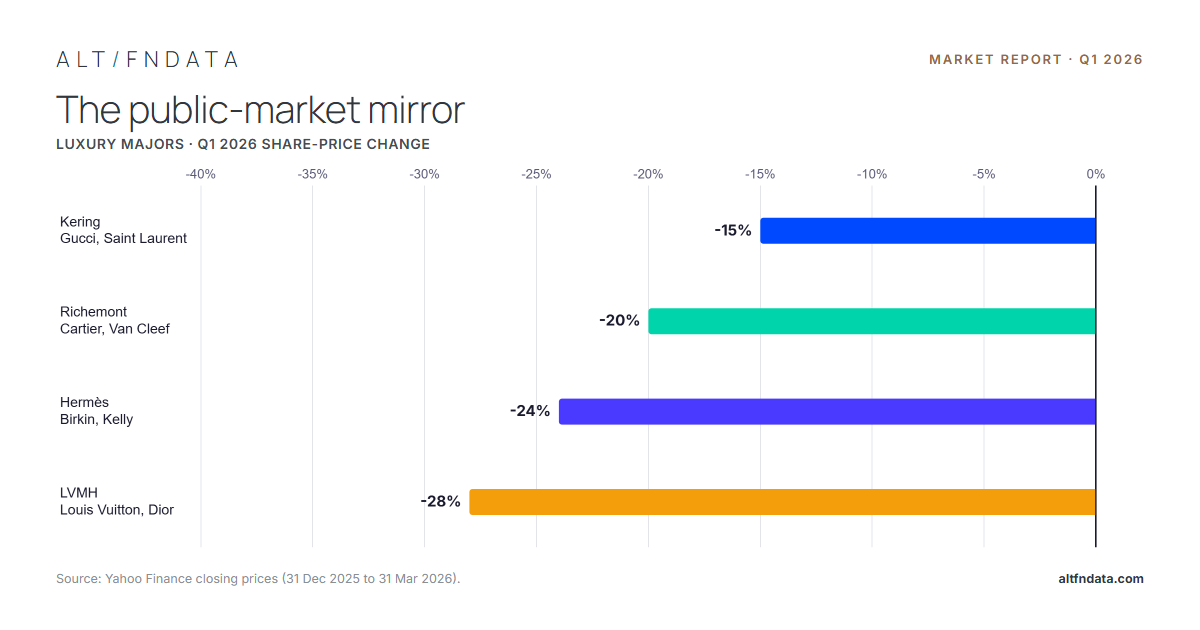
Two markets, one shock. As luxury equities had their worst start to a year in over a decade, the secondary auction market repriced in lockstep — a real-time readout on luxury demand for allocators.
The headline
The correction in three numbers
−72%
Auction value, YoY
Total sold-auction value fell from $12.9M to $3.6M (−70% like-for-like)
−74.6%
Top-lot price
The quarter’s pinnacle fell from $275,675 to $69,850
−25%
Volume (like-for-like)
1,653 → 1,233 lots at houses tracked in both quarters; −32% across all
Auction-realized prices — what luxury actually sold for at the hammer, not asking prices. · 15M+ auction results · 850+ houses.
The read
What the data shows
The quarter reprices the category rather than empties it: value and the top end fell far harder than volume, which means the market sorted rather than collapsed. Speculative, trend-led pieces gave up their gains while Hermès Kelly and Birkin references held their bid, so for a buyer or a holder the signal is plain: the foundational blue chips carry value through a demand shock, while the pieces that ran hardest on the way up give it back.
Members only
Read the full report
The headline data above is free to cite. The full report is part of ALT/FNDATA Membership, which includes every quarterly market report and the Visual Analytics Hub. Inside this report:
- The luxury-equity table (LVMH, Hermès, Richemont, Kering) and the auction↔equity correlation
- Month-by-month liquidity & capital-deployed data (Jan → Mar)
- Concentration: brand hierarchy, house share, and where capital actually cleared
- The pinnacle-lot repricing, full year-over-year drawdown, and methodology
Please enter a valid email address.
Thanks, your summary is on its way
We’ll email you the executive summary and keep you posted on new reports. The full report is available with ALT/FNDATA Membership.
Become a member to read the full report →Cite this report
Source: ALT/FNDATA, “Q1 2026 Report: The Secondary Market for Luxury Handbags & Luxury Equity Performance” (June 2026). Based on auction-realized prices for luxury handbags cleared at the auction houses ALT/FNDATA tracks, with public-market context from Q1 2026 luxury-equity performance. © 2026 ALT/FNDATA · altfndata.com/reports/luxury-handbag-market-report-q1-2026