

Watches, art, cars, jewelry, handbags, wine and more — cleaned, USD-normalized, and searchable.
Get Started →
London, 16 December 2021 - Friends of the National Libraries (FNL), the leading UK charity devoted to saving the nation's written and printed heritage, has successfully raised over £15 million to acquire the Honresfield Library for the nation, an unprecedented rescue of the country's literary heritage. The collection includes manuscripts by the Brontës, Jane Austen, Robert Burns and Sir Walter Scott, and FNL will donate every manuscript and printed book to libraries and writers' houses across the UK so that they are accessible to everyone.
The library was formed towards the end of the 19th century by William Law (1836-1901), a Rochdale mill owner, who created an exceptional collection of English and Scottish manuscripts and printed books which had the Brontës at its heart, as well as manuscripts in the hands of Jane Austen, Robert Burns and Sir Walter Scott and a significant collection of printed books. It has been largely inaccessible for the last 80 years.
When the sale of the library in three tranches was announced in May 2021, FNL successfully encouraged Sotheby's, the agents for the vendors, to postpone the sale of the first tranche planned for July 2021 in order to give FNL the opportunity to purchase the entire collection outright on behalf of appropriate recipient libraries within the UK. FNL has raised £15.3 million, of which the purchase price is £15 million, with the balance a combination of VAT and fees. Its success has ensured that the collection will remain permanently in the public domain and will never be lost to overseas institutions or to private collections that are not accessible to the public.
FNL and its consortium of libraries and writers' houses are profoundly grateful to their lead donor Sir Leonard Blavatnik who, with exceptional munificence, match-funded the sum raised by FNL and the consortium institutions. He has donated half the purchase price, and in recognition of his generosity the collection will henceforth be known as the Blavatnik Honresfield Library. It is the largest donation ever given to the UK by an individual for a literary treasure, safeguarding for the nation the most significant collection of manuscripts and books at risk of dispersal for many decades.
The acquisition was also made possible thanks to the vital support of the National Heritage Memorial Fund (NHMF), whose grant of £4 million is the largest it has ever awarded towards the acquisition of literary manuscripts since its foundation in 1980. Success would not have been possible without the generous support of each of the consortium institutions and of many funders, including The Prince of Wales Charitable Foundation, The Murray Family, Camelot Group, The Foyle Foundation, The David Cock Foundation, The T S Eliot Foundation, Hugh and Catherine Stevenson, the Berkeley Foundation, the British Library Collections Trust, the American Trust for the British Library, the B. H. Breslauer Fund of the American Trust for the British Library, The Ardeola Trust, The Vogel-Denebeim Family and the Penchant Foundation. Many other philanthropists, trusts and foundations who prefer to remain anonymous contributed, often with substantial gifts, alongside thousands of individuals who made personal donations to the appeal.
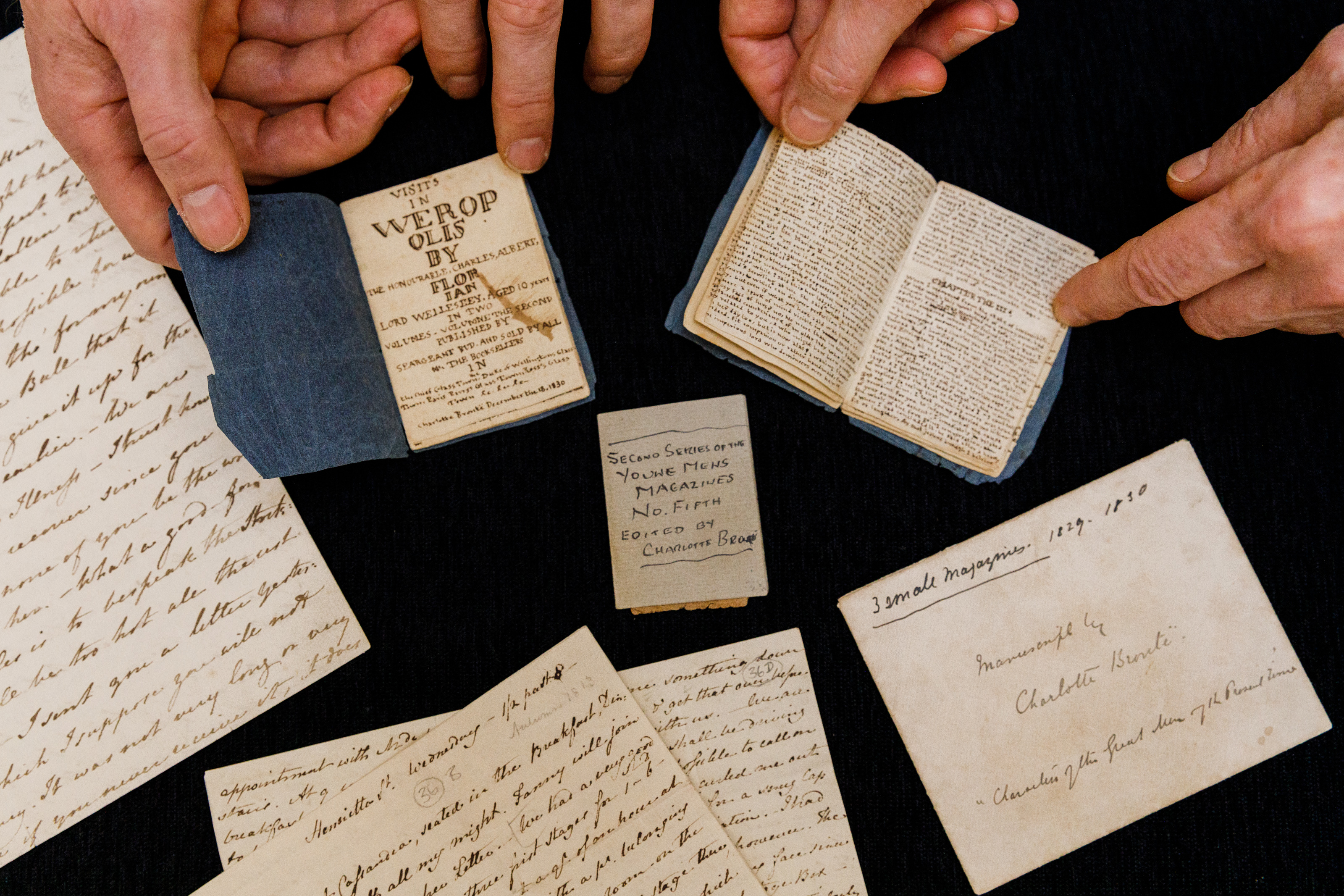
At the heart of the collection lies an astonishing set of manuscripts in the hands of Charlotte, Emily and Anne Brontë, much of which has been unseen for 80 years and never properly examined. It includes seven of Charlotte Brontë's famous "little books", each of which is a work of art; a manuscript collection of poems by Anne Brontë; some 25 letters by Charlotte Brontë; and a small but exquisite autograph manuscript diary note shared by Emily and Anne Brontë. The absolute jewel of the Brontë collection is Emily Brontë's holograph notebook of 31 poems, believed by many scholars to have been lost, which carries annotations in Charlotte's hand. The printed treasures of the sisters include Emily Brontë's own annotated copy of their first publication, the exceptionally rare Poems of 1846, and fine presentation copies of first editions of their novels in their original cloth bindings.
The collection also includes the complete working manuscript of Sir Walter Scott's iconic novel Rob Roy, part of the autograph manuscript of Scott's verse romance The Lay of the Last Minstrel, his light-hearted travel journal of a voyage off the Scottish coast in 1814, a copy of Border Antiquities with extensive manuscript revisions, and an exceptional group of Scott first editions in their original condition.
Other Scottish material of huge importance includes an early volume of poems by Robert Burns in his own hand, containing some of his earliest recorded literary works and known as the "First Commonplace Book", as well as individual autograph poems ("Cessnock Banks" and the "Brigs of Ayr"), and a group of the poet's earliest correspondence, including the only extant letter to his beloved father. Jane Austen is represented by two hugely significant letters to her sister Cassandra. One is the earliest known surviving autograph letter, dated January 1796, written on the eve of a ball where Austen anticipates the end of a love affair. Early autograph Austen letters are extremely rare, with only three held in any UK national collection and the bulk in the Morgan Library, New York. The second letter dates from 1813 and discusses the reception of both Pride and Prejudice and Sense and Sensibility. The collection also includes rare first editions of Pride and Prejudice, Emma, and Northanger Abbey and Persuasion in their original condition.
FNL will donate all of the manuscripts and printed books to relevant institutions across the country, ensuring that as many people as possible can enjoy this treasure trove of English and Scottish literature. At the end of the exercise, FNL will retain nothing. Taking a completely novel approach, FNL is leading a consortium of eight national, university and specialist collecting institutions to which all of the manuscripts will be donated. The approximately 1,400 printed books will be donated not only to the consortium members but also to a large number of institutions across the UK, spreading the benefit of the Blavatnik Honresfield Library still further.
The consortium members, receiving material by the Brontës, Jane Austen, Sir Walter Scott and Robert Burns, are the British Library in London and Yorkshire; the Brontë Parsonage Museum, Haworth; the Brotherton Library, University of Leeds; the Bodleian Library, Oxford; Jane Austen's House, Chawton; the National Library of Scotland in Edinburgh and Glasgow; Abbotsford: The Home of Walter Scott, Melrose; and the Robert Burns Birthplace Museum, Alloway (National Trust for Scotland). Details of the manuscripts that will be donated to each institution will be announced soon, as will plans for digitization, exhibitions, education and outreach, and research projects.
The benefits of this endeavor are manifold. The literary cornucopia will now belong permanently to the public domain in the UK. Manuscripts and printed books that have been inaccessible for some 80 years will be available for study by scholars, researchers, visitors and everyone, augmenting existing collections of literary works by all four principal authors, and the allocation policy will principally benefit libraries outside London.
HRH The Prince of Wales, Patron of FNL, said: "It is tremendous news for our country that Friends of the National Libraries, a charity of which I am proud to be Patron, has raised £15 million in just five months to save one of the most significant collections, including manuscripts by Charlotte Brontë, Walter Scott and Robert Burns. I can only congratulate the Chairman, Geordie Greig, and his team for saving the Blavatnik Honresfield Library for the nation, with its treasures now to be owned by some of our greatest national libraries across the UK. Our literary heritage is our cultural DNA and this preserves it for students, teachers, academics and ordinary readers in perpetuity."
Geordie Greig, Chairman of FNL, said: "The generosity of all the donors has been incredible in saving this unique library, especially Sir Leonard Blavatnik, who wonderfully matched the £7.5 million that we had raised, ensuring that our campaign to save the collection was successful. There has been unprecedented public interest in this collection of manuscripts and books hidden for almost a century. Rescuing it has seemed a little like opening an Egyptian tomb to see for the first time ancient texts and treasures which are now saved in perpetuity for students, scholars and book-lovers. Thanks to FNL's successful campaign the collection will be shared by libraries and writers' houses all across our island, restoring a treasure trove of manuscripts to their birthplaces."
Ros Kerslake CBE, Chief Executive of the National Heritage Memorial Fund, said: "We at the National Heritage Memorial Fund are delighted to have supported the campaign to save the Blavatnik Honresfield Library with £4 million, the largest amount we have ever granted towards an acquisition of literary manuscripts since our formation in 1980. This is truly a once-in-a-lifetime opportunity to acquire such an outstanding and nationally significant collection. The NHMF is a fund of last resort, and the astonishing array of manuscripts will join over 1,000 heritage treasures saved for the nation."
Dr Gabriel Heaton, Sotheby's English Literature and Historical Manuscripts Specialist, said: "This is a collection like no other that has come to market in recent decades. It preserves the original words of some of our greatest writers, from Robert Burns finding his poetic voice, to Jane Austen anticipating a proposal at a ball, to powerful romantic verses by Emily Brontë. It has been a great privilege to represent the family who have been careful custodians of these remarkable treasures ever since they were collected in the late 19th century. We were amazed and delighted at the incredible ambition of the FNL's plan to acquire the whole library, and they deserve every credit for bringing their campaign to a successful conclusion. Their success is a testament to what can be achieved by the collaboration of public institutions and private collectors."
The family of the original collectors, who had been the custodians of the library prior to the acquisition, said: "We are delighted that the Library is to remain in the UK and as the property of the nation, with many of the books and manuscripts returning to their birthplaces for all to see and enjoy."
(Press Release)