

Watches, art, cars, jewelry, handbags, wine and more — cleaned, USD-normalized, and searchable.
Get Started →
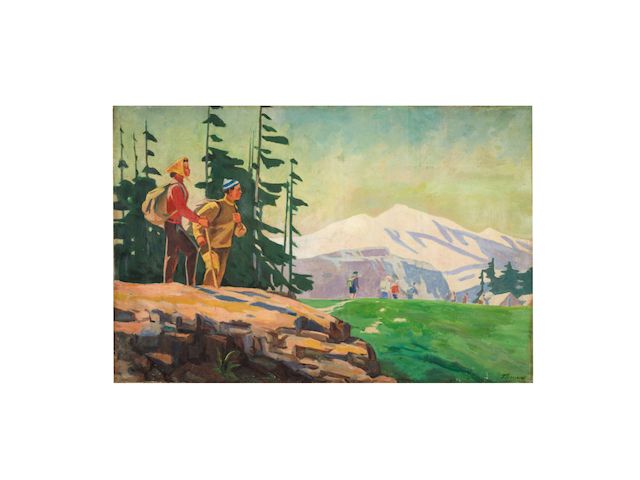
Paris, 26 January 2026 - Bonhams Cornette de Saint Cyr is going to organize a new online auction dedicated to Non-conformist art from the Soviet Union running from 16 to 26 January 2026. This auction will feature more than 55 paintings by artists such as Georgiy Grigorievich Nissky, Dmitry Krasnopevtsev, Nikolai Vechtomov, Leonid Anatolevich Purygin or Igor Shelkovsky. Among the highlights is an important oil on canvas from a private collection entitled Hikers by Georgiy Grigorievich Nissky (1903-1987) estimated at €50,000-70,000.
Georgy Nissky is considered as the founder of the so-called severe style, the master of the industrial landscape. Themes of his earliest known works, painted in the early 1930s, were apparently inspired by his childhood memories. In the postwar years the artist refers to the landscape scenery, he paints snowy forests, returning to the theme of the railways such as this painting. His works are in the State Tretyakov Gallery, the State Russian Museum, and in most of the major museums of the former USSR.
Daria Khristova, Head of Sale, said: "This auction brings together a curated selection of paintings and works on paper by leading Soviet and non-conformist artists from the Soviet Union. We are delighted to be offering these historically significant paintings signed by Nissky, Krasnopevtsev, Vechtomov, Purygin and Shelkovsky."
One of the key figures of unofficial art, Nikolai Vechtomov (1923-2007) was part of the core of the Lianozovo Group and took part in all the major nonconformist exhibitions. After the Second World War he began to experiment with abstract painting, filling small sheets of cardboard with spontaneous brushstrokes. His characteristic surrealist, expressive manner emerged in the 1960s, becoming a kind of reminiscence of his traumatic frontline experience. According to the artist himself, it was precisely the dramatic circumstances of the war that made him an artist. His style is easily recognisable by its striking orange-and-black or red-and-black contrasts, as well as by the lacquered surface of his paintings and the velvety quality of his watercolours.
Often described as an artist of the "cosmic" theme, Vechtomov created tense, fantastical works imbued with an inner glow and filled with isomorphic substances. Assuming the role of a creator, the artist seems to strive to touch upon the mysteries of the universe. His task was to sense and comprehend the laws of existence and to express them through new forms, thereby opening a window onto a new, unknown world of cosmism. Vechtomov's surrealism is far removed from the ideas of Magritte and Dalí, with their psychological automatism and hallucinatory visions. In Vechtomov's work, despite its apparent tragic quality, one senses a desire to anticipate the images of some new life, the forms of a new mode of being. At the same time, the color palette and biomorphic substances on his canvases serve as reminders of the horrors of war, so familiar to the artist.
Other highlights of the sale will include:
• Nature morte à la cruche by Dmitry Krasnopevtsev (1925-1995) is an oil on masonite board acquired directly from the artist in Moscow in 1970s (estimate: €30,000-40,000). By positioning himself against both official art and major unofficial trends, Krasnopevtsev developed a singular strategy and a personal visual language, inventing his own cults and rituals. Blending existential drama with discarded objects as allegories, he transformed banality into poetry, self-limitation into asceticism, and life's chaos into still lifes of hopeless, lifeless nature. One of his most significant works was his studio, part of which was transferred to the State Pushkin Museum. Filled with the pitchers, bottles, dried bouquets, and fish seen in his paintings, it was not a collection of models, since he did not paint from life, but an installation in itself, a work equal to all his others.
• Leonid Anatolevich Purygin (1951-1996), Tryptich: artist Natalia Batischeva, oil on panel (estimate: €4,000 - 6,000). A prominent representative of art brut, Leonid Purygin was one of the most 'atypical' artists of unofficial Soviet art. Lacking any formal artistic education, he began actively painting in the early 1970s. A solitary artist, Purygin chose his own artistic path, creating in a naïve style. The philosophy of his art is based on a unique mythological system filled with a variety of psychedelic characters and enigmatic commentaries. The central figure in his work is almost always the artist himself - Lyonya Purygin. The stylistic roots of Purygin's work lie in folk art, icons, and lubok prints. From these sources comes his love of bright colors, wood, folding icons, and folk religious imagery
• Igor Shelkovsky (born 1937) Homme qui marche/ Walking Man, acrylic on paper laid on canvas signed with initials (lower right) (estimate: €2,000 - 4,000)
(Press Release)