

Watches, art, cars, jewelry, handbags, wine and more — cleaned, USD-normalized, and searchable.
Get Started →
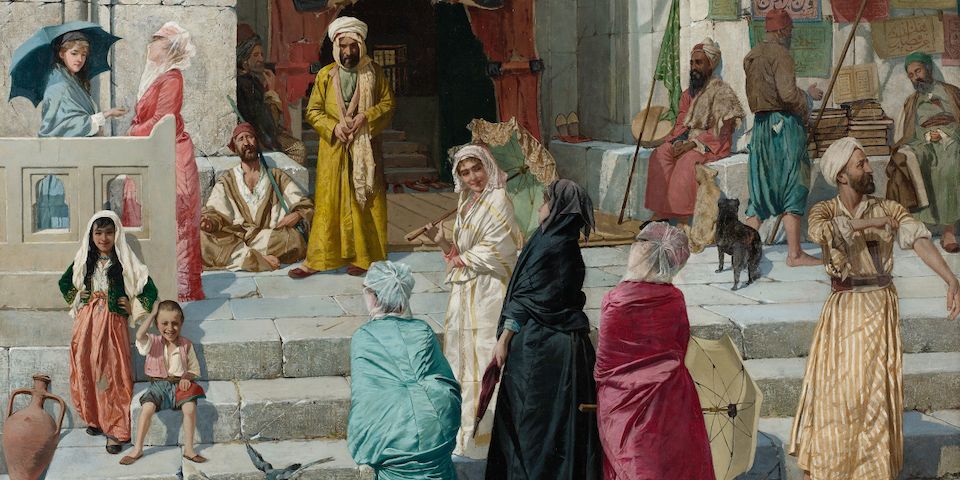
London, 24 May 1891 - Cami Kapisinda (At the Mosque Door), a major work by Osman Hamdi Bey (1842-1910) leads Bonhams' 19th Century Paintings and British Impressionist Art sale on 25 March at Bonhams New Bond Street, London. Having been acquired directly from the artist in 1895, the work comes to auction for the first time with an estimate of £2,000,000 - 3,000,000.
Charles O'Brien, Director of 19th Century Paintings at Bonhams, commented: "At the Mosque Door" is an outstanding example of the work of Osman Hamdi Bey, one of the most prominent figures of the Ottoman cultural milieu at the turn of the twentieth century. The painting comes to auction for the first time and has an outstanding and unbroken provenance having been acquired directly from the artist four years after its completion. It is magnificent in terms of both scale and detail, and as one of his first canvases of such monumental dimensions, it stands as a perfect example of the merging of a contemporary street scene with some of the architectural features of a fifteenth-century Ottoman mosque. It adds significantly to our understanding of Orientalist Art as espoused by an Ottoman artist who had a remarkable ability to make Western observers believe that his scenes reflected the reality of daily life in his homeland. At the Mosque Door stands as a major milestone in the oeuvre of one of the most fascinating painters of his time, this is certainly a very exciting opportunity for collectors."
Osman Hamdi Bey (1842 to 1910) acquired an informal training in Paris with Gustave Boulanger, and under the influence of the famous Orientalist painter Jean-Léon Gérôme. One of the first Ottoman artists to bridge the artistic worlds of Turkey and France, Hamdi Bey's works in many respects mirrored the Orientalist subjects that were so successful in Europe at the time.
On his return to Turkey in 1868 Hamdi Bey took up a position within government administration and was sent to Baghdad where he was Director of Foreigners Issues, returning to Constantinople in 1871, where he continued to pursue painting.
He was appointed Head of the newly formed Archaeology Museum in Constantinople in 1881, and by obtaining the publication of the 1884 bylaw that forbade the export of finds, he established a de facto monopoly over antiquities, which gave him power and leverage over foreign archaeologists, while providing the museum with a steady flow of artifacts. Ten years into his term, he had managed to reach his major goal: international visibility and recognition for his museum and for himself. As a result, he became a hugely important and influential figure among Western archaeologists and governments who were undertaking archaeological digs in the country to uncover artifacts that would increase knowledge of the ancient world.
At the Mosque Door was first exhibited at the International Art Exposition of Berlin in 1891, together with two other of his paintings, Reading from the Quran and Turkish Interior. At the Mosque Door did not however make it to the opening. On 24 May 1891, Hamdi wrote to Carl Humann: "The large painting is completed and it left last Thursday [21 May] with the Orient Express, as the exhibition committee granted me an extension to finish it."
At the Mosque Door was painted as a companion to Women in a Türbe (Mausoleum), the artist intended to show both pictures at the World's Columbian Exposition in Chicago in 1893, but both works were exhibited in Paris, and the latter was purchased by the French state. This acquisition was surely made in a move to curry favor with the artist who by now controlled the licencing of archaeological digs and the export of archaeological material excavated in all Ottoman lands.
At the Mosque Door was ultimately sent to America for the Chicago Fair and the picture was purchased by The University of Pennsylvania in 1895. The hope was that this gesture would ensure that work being carried out by the University Museum's archaeological expedition to the site of Nippur might continue. The gesture was successful in cementing the relationship between artist and University, and in 1897 Hermann Hilprecht, the Museum's representative in Constantinople, wrote to the University confirming that Hamdi had given the Museum a collection of important cuneiform tablets.
The setting of At the Mosque Door is identifiable as the main entrance to the Muradiye Mosque at Bursa. There are four other paintings by Hamdi depicting the same setting. There is no specific narrative or 'event' such as depicted in Hamdi's Koranic scenes. This work may well be interpreted as a transition from his 'soft' harem scenes to a new version of Orientalism, characterized by a great awareness of the Ottoman heritage, as embodied in architectural and decorative elements and created for a Western audience.
Though a real location, At the Mosque Door is a perfect example of Hamdi's skills at authenticating an imaginary, and in some ways implausible, scene that he had assembled bit by bit, almost as in a collage with the size of the door enlarged and steps added, alongside all the expected intense colors and key Orientalist tropes. Women wearing feraces, an overcoat worn by women outside of the home, a typical costume of Muslim women in Ottoman cities, marks the scene as contemporary, rather than historical. Only one of the books is open and its page design suggests it may be a Quran. The second book from the bottom up in the rightmost pile reads "Kamus" (Ocean), generally associated with Firuzabadi's famous Arabic dictionary. What is written on the side of the book just above it is not a title, but "Osman Hamdi", the artist's name, a 'secret signature' in the Arabic script. Hamdi often represented himself in his paintings, more in the logic of a model than a true self-portrait. Rather exceptionally, this painting stages not one, but three, Hamdis, left to right, as a cross-legged beggar, as a turbaned man standing right next to him, and in the foreground, as yet another man rolling up his sleeve.
In 2019, Bonhams sold Osman Hamdi Bey's Young Woman Reading for £6.6 million, a world record price for a work by the artist at auction.
NEW YORK PREVIEW at 111 West 57th Street
9-12 February
We are grateful to Edhem Eldem, Sakıp Sabancı Visiting Professor, Department of History, Columbia University for his kind assistance.
(Press Release)