

Watches, art, cars, jewelry, handbags, wine and more — cleaned, USD-normalized, and searchable.
Get Started →
Strong prices achieved by exceptional Meissen porcelain pieces from a collection assembled in East Asia as well as Old Masters in Bonhams Paris Classics
Paris - The Classics auction series returned to Bonhams Cornette de Saint Cyr in Paris on 21 and 22 April with two live sales spanning over four centuries of art and antiques. This season's edition included a Private Asian Collection of Early Meissen Porcelain assembled in East Asia, including remarkable pieces from the collection of Augustus the Strong, Elector of Saxony and King of Poland. This sale took place on 22 April following the sale of Old Master and 19th Century Paintings on the 21st April.
The Classics sales at Bonhams Cornette de Saint Cyr in Paris achieved a total of €1,996,176. Marking a major milestone for Bonhams, this sale was the first auction of a private Asian collection of European porcelain and the latest milestone in the long history of cultural exchange between the Far East and Europe.
The Old Masters and 19th Century Paintings sale at Bonhams Cornette de Saint Cyr in Paris achieved a total of €1,7 million.
Nette Megens, Group Head, Classics for Europe and UK, said: "We are delighted by the results. We saw a particularly high level of interest and bidding from new clients, including a significant number from France. A noticeable change in the market for Classics is that we are welcoming collectors seeking quality across a range of categories, and these collectors are adding new energy to sectors such as Old Master paintings, furniture and porcelain. We now look forward to the second half of the Classics season in July in London, including an important pair of late medieval royal heraldic embroideries."
An Impressive silver-gilt champlevé enamel casket by Pavel Ovchinnikov executed in Moscow circa 1873 was the leading lot at Bonhams Classics Sale in Paris on Wednesday 22 April. The work sold for €356,000, over ten times the high estimate.
Furthermore, an exceptional pair of Greek-style mahogany and mahogany-veneered commodes, stamped J.F. Oeben and dating circa 1760 sold for €229,000. They were almost certainly delivered around 1760 to the Marquise de Pompadour for her castle of Ménars.
The collection of Meissen porcelain was highlighted by a rare Augustus Rex celadon-ground baluster vase and cover, circa 1730, which sold for €61,360. This piece came from the collection of Augustus the Strong, Elector of Saxony and King of Poland. A Meissen Böttger stoneware black-glazed and gilt teabowl and saucer, circa 1711-15, decorated in the workshop of Martin Schnell with a deep black manganese lustre in imitation of Japanese lacquer sold for €32,000.
Other highlights of the sale included:
• An Impressive silver-gilt and champlevé enamel wine set by Pavel Ovchinnikov, Moscow, 1873, sold for €229,000. The stylistic language of the set reflects designs created in 1861 by the architect and designer Ippolit Monighetti (1819 to 1878), now in the State Hermitage Museum in St. Petersburg. It is believed that this service was commissioned to represent Russian artistic craftsmanship at the Vienna World Exhibition of 1873.
• A rare and large Hispano-Moresque armorial basin, Valencia, probably Manises, third quarter 15th century sold for €102,000. Other similar large basins, some armorial, are in the collection of the Museo Nacional de Cerámica y Artes Suntuarias "González Martí" in Valencia. Further large armorial basins with blue and lustre decoration are in the collection of the Hispanic Society of America and the Metropolitan Museum of Arts.
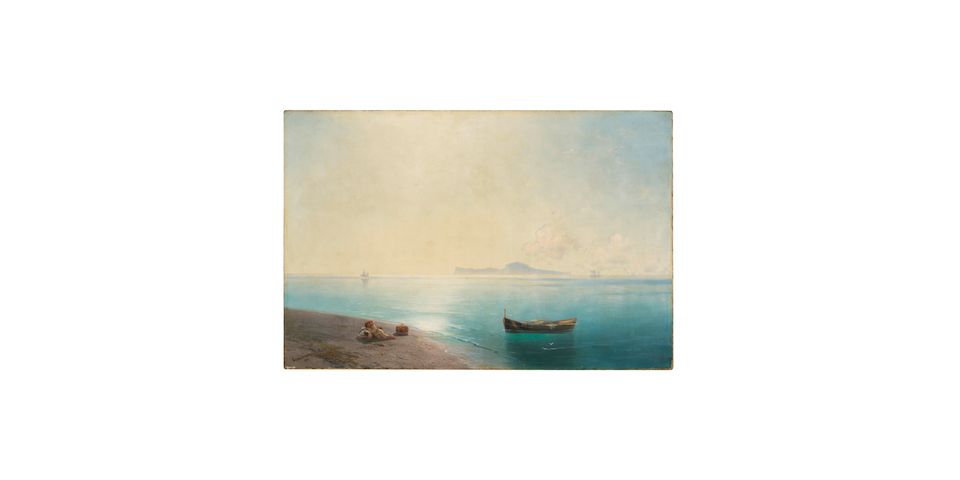
Leading the highlights from the Old Master and 19th Century Paintings on 21 April 2026 in Paris, was View of Capri, a stunning oil on canvas dated 1889 by Ivan Aivazovsky (1817-1900). This incredible piece was estimated at €250,000 to 350,000 and sold for over twice the estimate at €825,900.
"Ivan Aivazovsky occupies a distinguished place in art history as the first Russian marine painter and as one of the most significant European masters of the genre" says Daria Khristova, Director of the Russian department at Bonhams. "His childhood spent by the sea decisively shaped his artistic path; he became an outstanding interpreter of maritime subjects and is widely regarded as the pre-eminent master of seascapes."
The painting's palette showcases the artist's remarkable technical skill. Soft gradations move from pure sky blues to subtle, pearly tones near the coastline, lending the composition a harmonious unity. The vast sky, occupying much of the canvas, transitions almost imperceptibly from cool blues overhead to warmer golden hues at the horizon. The entire scene feels infused with light and the crisp freshness of sea air, a fleeting natural atmosphere that Aivazovsky captured with exceptional sensitivity. In this work, he demonstrates an extraordinary ability to render delicate variations of light and mood, conveying the tranquil stillness of a languid Italian day.
Other highlights of the sale included the masterful rendering of the interior of Antwerp Cathedral by Pieter Neefs the Elder (Anvers 1578-1656), which exemplifies the artist's unrivalled command of architectural perspective and atmospheric light (estimate: €30,000-50,000) and sold for an impressive €127,400.
This refined composition on panel is characteristic of Neefs' mature period, when his depictions of Antwerp Cathedral reached a level of compositional harmony and optical sophistication that secured his reputation across Europe. The present painting also boasts a distinguished provenance, having once formed part of the collection of Sir Bruce Ingram, the influential British editor and noted patron of the arts, whose discerning eye helped shape several eminent collections in the early 20th century.
La bataille du Pont Milvius by a follower of Giulio Romano, early 17th century, oil on canvas, unlined, sold for €114,700. This striking and monumental canvas, executed by a follower of Giulio Romano, is an accurate and presumably early copy after the celebrated Battle of the Milvian Bridge fresco in the Sala di Costantino, Apostolic Palace, Vatican Museums. The decorative scheme was designed by Raphael and executed by Giulio Romano and his workshop circa 1520 to 1524, begun under Pope Leo X and completed during the pontificate of Clement VII. The composition displays the hallmarks of Roman Mannerism, energetic diagonals, tightly interwoven bodies, and heightened drama, translated with remarkable fluency by an artist very familiar with Romano's visual language.
(Press Release)