

Watches, art, cars, jewelry, handbags, wine and more — cleaned, USD-normalized, and searchable.
Get Started →
London, 28 May 2026 - From real stories of World War Two codebreaking to the allure of James Bond, Bonhams sale Espionage: Fact and Fiction, proved a hit with collectors when it ended today (28 May) on bonhams.com.
Rebecca Anthony, Head of Sale, commented: "From fact to fiction, this sale really captured the imagination of collectors, showing both the pull of historic items in this field and the continued allure of Bond. We are delighted with the results."
Highlights of the sale included:
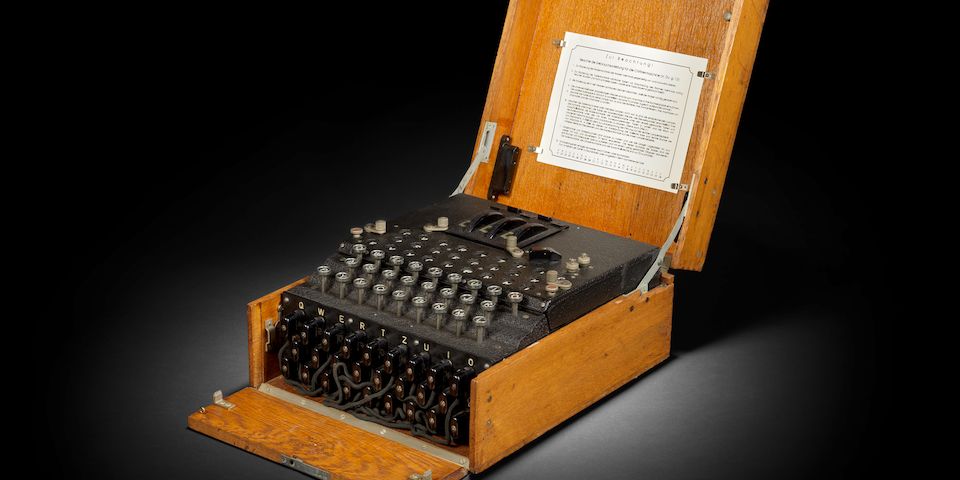
• A Rare 3-rotor Heimsoeth & Rinke Enigma I Cipher Machine, German, circa 1941. Sold for £203,600.
This example of the standard three rotor enigma machine was used principally by the army (Wehrmacht) and was their favoured cipher device. British attempts to break the Enigma cipher were fruitless for years. The breakthrough eventually came after the creation of the famous British codebreaking center Bletchley Park in 1937. Using the technology transferred to them from the brilliant Polish codebreaking team in 1939, as well as documents supplied by the French Intelligence from a German spy, Alan Turing, along with Knox, Foss and many others were able to break the Enigma code, shortening the war by an estimated two years, and saving countless lives.
• James Bond: The Original Scubacraft from Q's Workshop in the film Spectre, circa 2015. Sold for £51,200.
The Scubacraft SC3 is a three-person amphibious diving craft developed as the original prototype of the Scubacraft concept and believed to be the only surviving example of the SC3 prototype in existence. The craft was conceived to operate both as a high-performance surface vessel and as a submersible diving platform.
Conceived and engineered through the late 2000s following several years of design, development and testing, the project resulted in the construction of this full-scale experimental prototype.
From an early stage, the project attracted international attention from both commercial and government sectors, including interest from organisations such as the UK Special Boat Service and the US Defense Advanced Research Projects Agency (DARPA), alongside coverage in the international diving and marine technology press. Despite significant interest and development activity, only a single SC3 prototype was ultimately constructed.
Today this SC3 prototype is believed to be the only surviving example of the Scubacraft concept, representing a unique experimental marine platform that combines genuine engineering innovation with striking design, which in turn attracted the attention of Eon and James Bond.
In 2015, Robin Harris, Engineering Director on the Scubacraft development program, was contacted by the James Bond production team having encountered an article describing the Scubacraft and recognized its potential. The presence of the craft attracted considerable interest from members of the production crew, many of whom were intrigued by the idea of a vehicle capable of operating both as a high-speed surface craft and as a submersible diving platform. According to the Harris, Daniel Craig himself expressed particular interest in the vehicle, taking time between filming to learn more about its design and capabilities, a level of genuine technological innovation that felt particularly fitting for James Bond himself.
The Scubacraft was on set for the scenes filmed in Q's workshop at Pinewood Studios, where it occupied its own dedicated space within the laboratory environment. Eon Productions also invited Harris to play a supporting role in Spectre as a technician in Q's workshop.
• FLEMING (IAN), The Complete Works, 18 vol., Centenary Edition, ONE OF 26 COPIES LETTERED A-Z, THIS BEING COPY 'T', Queen Anne Press, 2008. Sold for £25,600.
• Two Konski & Kruger cipher rotors in original pine case, German, circa 1938. Sold for £12,800. Additional rotors IV and V were introduced for Enigma machines in December 1938. This increased the number of combinations for rotor order by 10 times (from 6 to 60), an improvement for cipher security.
• Poster for Rear Window, Paramount, 1954. Sold for £3,328.
(Press Release)