

The market in one word
Ask the collector-car market to describe its first half in one word and the honest answer is a marque. Across 310,833 sold results with realized prices in our record, Ferrari took 21 percent of every dollar spent at collector-car auctions in H1 2026, the highest share in our series, on roughly two percent of the sold lots. The number has been climbing for years: 12.9 percent in 2019, 16.9 in 2023, 19 across 2025, and now one dollar in five. Concentration like that is not a quirk of a strong season. It is the structure of the market.
| Period | Sold value (all cars) | Ferrari share of value | Million-dollar cars that were Ferrari |
|---|---|---|---|
| 2019 | $1.18B | 12.9% | 35 of 133 (26%) |
| 2021 | $1.58B | 16.6% | 63 of 205 (31%) |
| 2023 | $2.44B | 16.9% | 89 of 256 (35%) |
| 2025 | $2.98B | 19.0% | 99 of 360 (28%) |
| H1 2026 | $1.02B | 21.0% | 32 of 81 (40%) |
The million-dollar line
The concentration sharpens exactly where the money is. Eighty-one cars cleared $1 million at auction in the first half; 32 of them, two in five, were Ferraris. Across the full span since 2019 the marque has taken better than one in four of all million-dollar results, and no other manufacturer approaches that share. Seven-figure results are decided by the depth of the bidder pool, and the pools are deepest, sale after sale, for the same badge. That is what it means for liquidity to concentrate: the marque with the most trophies is also the marque where trophies are easiest to sell.
The ladder is scarlet
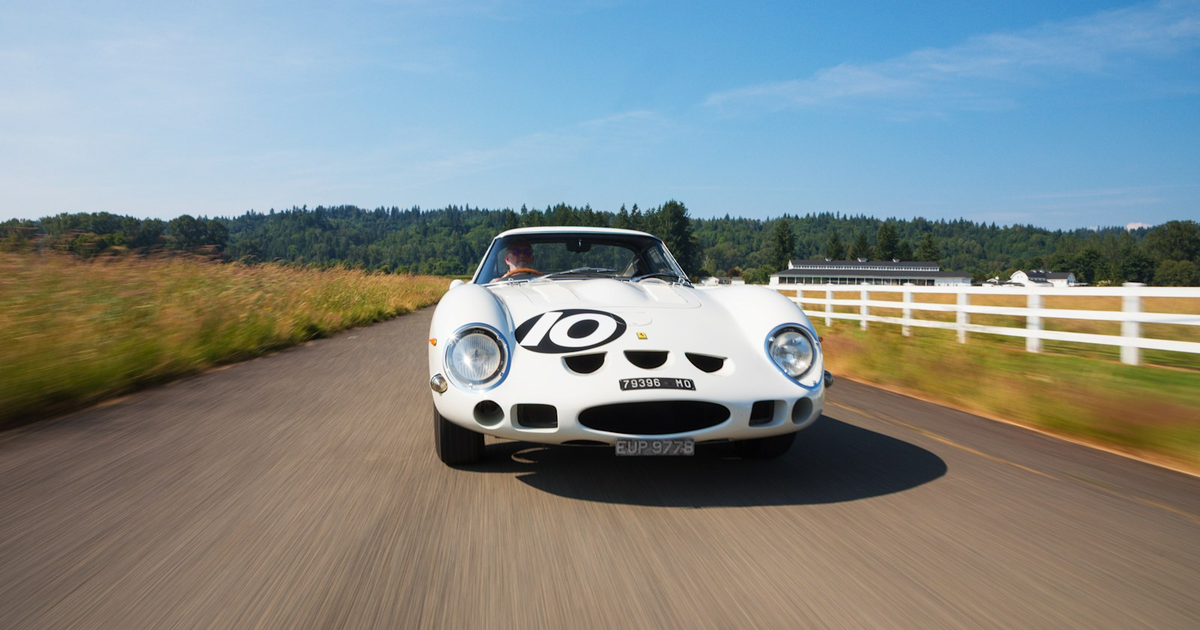
Nine of the ten most expensive cars in our record are Ferraris. The ladder runs from the $48.4 million 1962 250 GTO sold at RM Sotheby's in 2018, through the $38.5 million 250 GTO that led Mecum Kissimmee this January, the $38.1 million ex-Schlesser GTO, the $36.2 million 250 LM sold in early 2025, and the $35.2 million 335 Sport, down to a car built twenty-four months ago: the $26 million Daytona SP3 Tailor Made, sold new in 2025 as an instant collectible. One car interrupts the run, the ex-Fangio Mercedes W196 at $29.8 million in 2013. Everything else at the top of 310,833 results wears the same badge, across six decades of production.
The Enzo tape
If the share series shows the structure, the first half's Enzo sales show the mechanism. Kissimmee in January produced a $17.9 million Enzo, roughly triple the model's previous auction record, and, the same night, an $11.1 million example in Rosso Dino, the only one made in the colour. By mid-June the Rosso Dino car had sold again, online, for $13.0 million: a gain of $1.9 million in five months, with twelve miles added to the odometer. Days later a grey example made $10.2 million. Four results, one model, six months. That is a repricing happening in public, each sale confirming the last, which is precisely what deep, liquid demand looks like, and precisely what most collectible markets never achieve.
What this means
For dealers and collectors, the share series is a map of where the market actually clears. Ferrari's slice of sold value means its comparables are the densest, its estimates the best calibrated, and its exits the most reliable; a seven-figure car of any other marque is, statistically, a rarer and lonelier trade. For allocators, it means collector cars are not a diversified asset class at the top: to a first approximation, the category's performance is Ferrari's performance, and the marque's realized-price series is the benchmark to track.
And the two-markets lens our H1 scorecard applied to luxury applies here in miniature. Ferrari the stock finished the half up 0.7 percent, roughly flat; Ferrari the objects took a record share of a billion-dollar half, reset the Enzo's price three times, and put a two-year-old car on the all-time ladder. The company and the objects are different assets, and in H1 2026 the objects were the stronger market. We will keep scoring both, in realized prices, sale by sale.
What to take away
One marque, one structure, three disciplines:
Concentration is liquidity
Two of five million-dollar results in one marque means the deepest bidder pools, the cleanest comparables and the most reliable exits are Ferrari's. For anyone consigning or collecting at the top, marque risk and market risk are converging.
The instant collectible is a Ferrari phenomenon
A 2025-built Daytona SP3 sits on the same all-time ladder as the 1962 GTOs, and an Enzo repriced by $1.9 million between January and June. No other marque's new production trades as an appreciating asset at this scale.
Watch the share, not just the records
Records make headlines; the share series is the signal. Ferrari's slice of sold value has risen in five of the last seven years and just printed its high. If it keeps climbing, the collector-car market's fortunes and Ferrari's are the same trade.
Ferrari took 21 percent of the sold collector-car market in H1 2026, two of every five million-dollar results, and nine of the ten most expensive cars in our record, and a single Enzo repriced itself by $1.9 million between January and June. None of this is a tip; it is the structure of the market, visible only in realized prices. The share series has risen in five of the last seven years. Whether it keeps rising is the single most important question in collector cars, and it will be answered where it was asked: at the hammer.
“One lot in fifty, one dollar in five. The collector-car market is not a market with a strong Ferrari segment; it is a Ferrari market with a long tail.”
Methodology & about
Methodology
This is a market read. Figures are from ALT/FNDATA's record of 10M+ auction results across 100+ houses: 310,833 collector-car lots with status Sold and a realized price, 2019 through June 30, 2026, in USD at nearest-date exchange rates. Marketplace asking-price listings (including 37,500 Classic Autotrader listings) are excluded by sale status. Ferrari attribution uses the catalogued marque with a title-match backstop. Share figures divide Ferrari realized value by all realized value per period; the million-dollar counts use the same basis. The all-time ladder reflects production-week data-quality fixes: two corrupt non-Ferrari prices were corrected against source pages and duplicate listings of one Bonhams lot were removed before ranking. January Kissimmee results (the $38.5 million 250 GTO, $17.9 million and $11.1 million Enzos) are in our capture; the June Enzo results ($13.0 million, twelve miles added, and $10.2 million) are per public reporting by Carscoops, Magneto and duPont Registry and are not yet reflected in our capture. Ferrari N.V. equity figure per Yahoo Finance daily closes, H1 2026.
ALT/FNDATA is a market-data platform tracking 10M+ auction results across 100+ houses worldwide: the neutral, cross-market record of what luxury and alternative assets actually sell for at the hammer, not asking prices.
Cite this report
Source: ALT/FNDATA, “Why One in Five Collector-Car Dollars Now Goes to a Ferrari” (July 2026). Based on 310,833 sold collector-car results with realized prices in ALT/FNDATA's record, 2019 through H1 2026, plus publicly reported June 2026 Enzo results. © 2026 ALT/FNDATA · altfndata.com/reports/ferrari-concentration-2026