

The quarter in brief
The secondary market for luxury handbags continued to cool in the fourth quarter of 2025, though the contraction was uneven. Total realized value fell approximately 40% year over year, from $30.9M to $18.6M (down 38% on a like-for-like basis), while the number of sold lots declined a more contained 15%. Beneath the aggregate the market narrowed: capital consolidated into Hermès and into the two flagship houses, and the very top of the market strengthened even as the broader book thinned.
−40%
Auction value, YoY
Q4 sold-auction value fell from $30.9M to $18.6M (−38% like-for-like)
$489,966
Top lot, +111% YoY
A rare matte Béton alligator Hermès at Christie's; the 2024 top was $231,879
94%
Hermès share of value
$17.5M of $18.6M cleared, across 882 sold lots
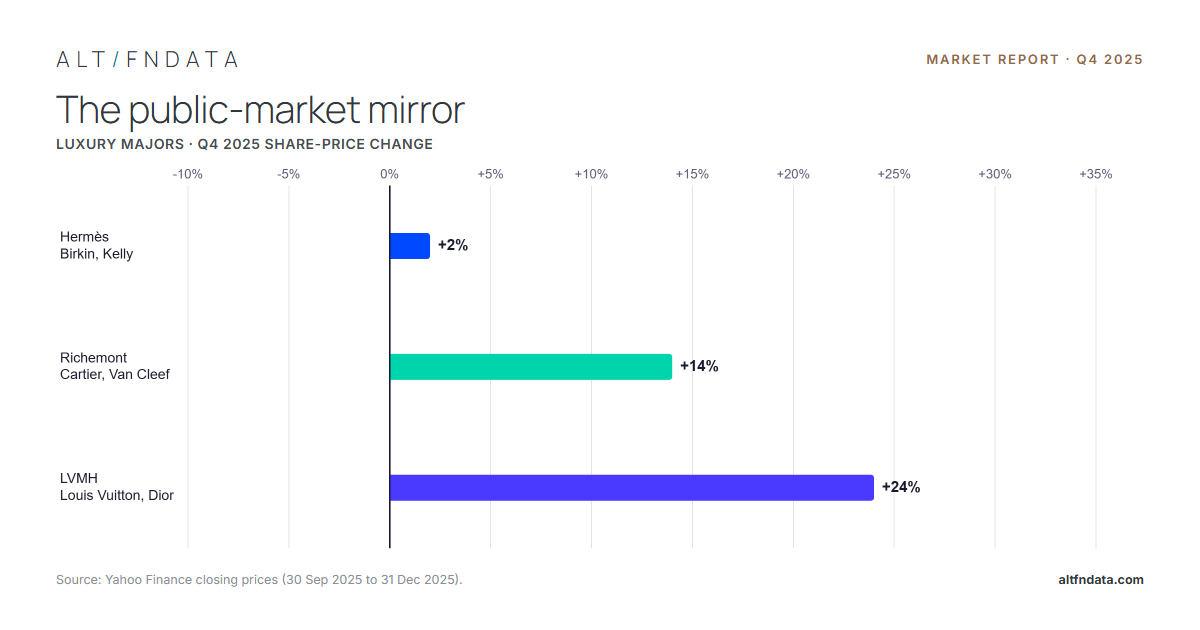
The public-market mirror: luxury equities in Q4 2025
The auction room did not move with the listed houses. After a difficult year, luxury equities staged their sharpest rally of 2025 in the fourth quarter. LVMH rose approximately 24% over the three months, Richemont about 14%, and Hermès around 2%, as the sector repriced from cyclical pessimism toward stabilization.
While the secondary handbag market kept cooling (auction value down approximately 40% year over year), the listed luxury houses staged their sharpest rally of 2025, rising 2% to 24% in the fourth quarter on a return to growth and easing tariffs. The saleroom is the slower, higher-conviction signal, and its continued softness preceded the broad repricing of Q1 2026.
Source: Yahoo Finance closing prices (30 Sep 2025 to 31 Dec 2025).
The catalysts were specific and public. LVMH returned to organic growth in its October results, the first such reading of 2025, and its shares posted their largest single-session gain since 2001; China demand showed early signs of stabilizing; and in mid-November the United States and Switzerland agreed to cut tariffs on Swiss goods from 39% to 15%, easing a pressure that had weighed on the sector all year. Kering, mid-turnaround under its new chief executive Luca de Meo, sold its beauty division to L'Oréal for approximately EUR 4.0bn but still closed 2025 down roughly a quarter, the laggard of the group. Gold, up about 65% across the year, lifted the intrinsic floor beneath the most exotic pieces.
The signal for the secondary market
The listed houses and the saleroom repriced in opposite directions through the fourth quarter: equities rallied on the prospect of recovery while auction value kept declining. The auction room is the slower, higher-conviction reading, and its continued softness foreshadowed the broad repricing that followed in the first quarter of 2026.
Month by month (Q4 2025)
October: a soft open
The quarter opened quietly, with 584 sold lots for approximately $2.4M, the autumn flagship sales not yet underway and activity distributed across the European mid-market houses.
November: the value peak
November was the high point, 731 lots for roughly $9.5M, concentrated in the late-November flagship sales. Christie's led, clearing the quarter's most valuable lots, a series of matte alligator Hermès headed by the $489,966 Béton, the single top result of the quarter.
December: easing into year-end
December moderated to 826 lots for about $6.7M, with value again concentrated at Sotheby's and Christie's and in foundational Hermès references, closing the year well below its prior-year level.
Concentration: Hermès and the flagship houses
More than in any other quarter of 2025, value gathered in a narrow set of names and rooms. Hermès accounted for roughly 94% of realized value, $17.5M across 882 sold lots, while Louis Vuitton (205 lots), Chanel (127) and Dior (83) divided a marginal remainder.
Foundational references
Within Hermès the two pillars carried the quarter: 278 Kelly and 264 Birkin lots cleared, alongside 55 Constance. Bidders concentrated in the references that hold value through a downturn rather than in trend-led pieces.
The flagship houses
Sotheby's ($8.9M across 481 lots) and Christie's ($8.8M across 258 lots) together cleared approximately 95% of the quarter's value, the highest concentration of the year. The mid-market European houses, Rossini, Gros & Delettrez, Webb's and Millon, supplied volume but little of the capital.
Year over year: Q4 2024 vs. Q4 2025
A year-over-year comparison shows a market that contracted in aggregate while strengthening at its apex. The brand hierarchy was unchanged, with Hermès foremost, but the capital deployed tells the story of the quarter.
| Metric | Q4 2024 | Q4 2025 | Change |
|---|---|---|---|
| Sold auction lots | 2,515 | 2,141 | −15% |
| Like-for-like lots | 2,026 | 1,317 | −35% |
| Total value (USD) | $30.9M | $18.6M | −40% |
| Like-for-like value | $29.6M | $18.3M | −38% |
| Top marquee lot | $231,879 | $489,966 | +111% |
The clearest signal sits at the top. Q4 2024's high was a $231,879 Hermès at Sotheby's; Q4 2025's was a $489,966 matte Béton alligator Hermès at Christie's, an increase of approximately 111% at the very top even as aggregate value fell 40%. The most exceptional, unrepeatable pieces appreciated while the broader market receded, the defining pattern of the quarter and a preview of the bifurcation that would dominate 2026.
What the fourth quarter signals
The fourth quarter of 2025 reads as a market consolidating into its core rather than collapsing across it. Three patterns are likely to carry into 2026:
The barbell hardens
Capital is concentrating at the very top, foundational Hermès above all, while the speculative middle thins. The top lot more than doubled year over year even as aggregate value fell 40%, so scarcity at the pinnacle is appreciating while breadth recedes.
Hermès as the market
At roughly 94% of value, Hermès is no longer the leading brand so much as the market itself. The Kelly and Birkin function as the store of value through the downturn, and everything else clears at the margin.
Equities and the saleroom diverged
The listed luxury houses rallied hard into year-end on stabilization and tariff relief, while the auction room kept cooling. The two had repriced in opposite directions by December, a gap the first quarter of 2026 would close.
The secondary handbag market closed 2025 narrower and more selective than it began the year. Value gathered at the pinnacle and in Hermès while the middle receded, and the listed luxury houses rallied even as the saleroom cooled. That divergence set the stage for the repricing that arrived in the first quarter of 2026, when the broad market finally followed the very top down.
“By the close of 2025 the secondary handbag market had narrowed to its core: Hermès took almost all of the value, the very top lots strengthened, and everything in between receded.”
Methodology & about
Methodology
This report draws on ALT/FNDATA's record of luxury-handbag lots cleared at auction worldwide, filtered to completed auction sales (excluding marketplace listings and unsold or withdrawn lots). Q4 2025 reflects 2,141 sold lots ($18.6M); Q4 2024, 2,515 ($30.9M). Because the set of houses tracked shifts from quarter to quarter, year-over-year figures are reported both across all houses (value −40%, volume −15%) and on a like-for-like basis for the eight houses that cleared lots in both quarters (value −38%, volume −35%). Values are realized prices converted to USD at nearest-date exchange rates. Luxury-equity figures are Q4 2025 (October to December) share-price changes and company results as reported by the issuers and the financial press.
ALT/FNDATA is a market-data platform tracking 13M+ auction results across 100+ houses worldwide: the neutral, cross-market record of what luxury and alternative assets actually sell for at the hammer, not asking prices.
Cite this report
Source: ALT/FNDATA, “Q4 2025 Report: The Secondary Market for Luxury Handbags” (June 2026). Based on auction-realized prices for luxury handbags cleared at the auction houses ALT/FNDATA tracks, with public-market context from Q4 2025 luxury-equity performance. © 2026 ALT/FNDATA · altfndata.com/reports/luxury-handbag-market-report-q4-2025
Prefer a PDF? Download this report as a PDF →