

One week, two extremes
The first week of July gave the art market its cleanest split-screen in years, and both halves belonged to the same house. Upstairs at Christie's, Classic Week's evening sales set seven world auction records; the Old Masters evening alone made £38.9 million, clearing its high estimate, with just three lots failing to sell. Online, the same week, Christie's sale of works from the Zabludowicz Collection found buyers for 20 of its 44 lots, 55 percent unsold, and totaled £95,377 against a presale estimate of £292,000 to £435,400. One market produced both results within days of each other. The question worth answering is what kind of market does that.
Upstairs: records with depth
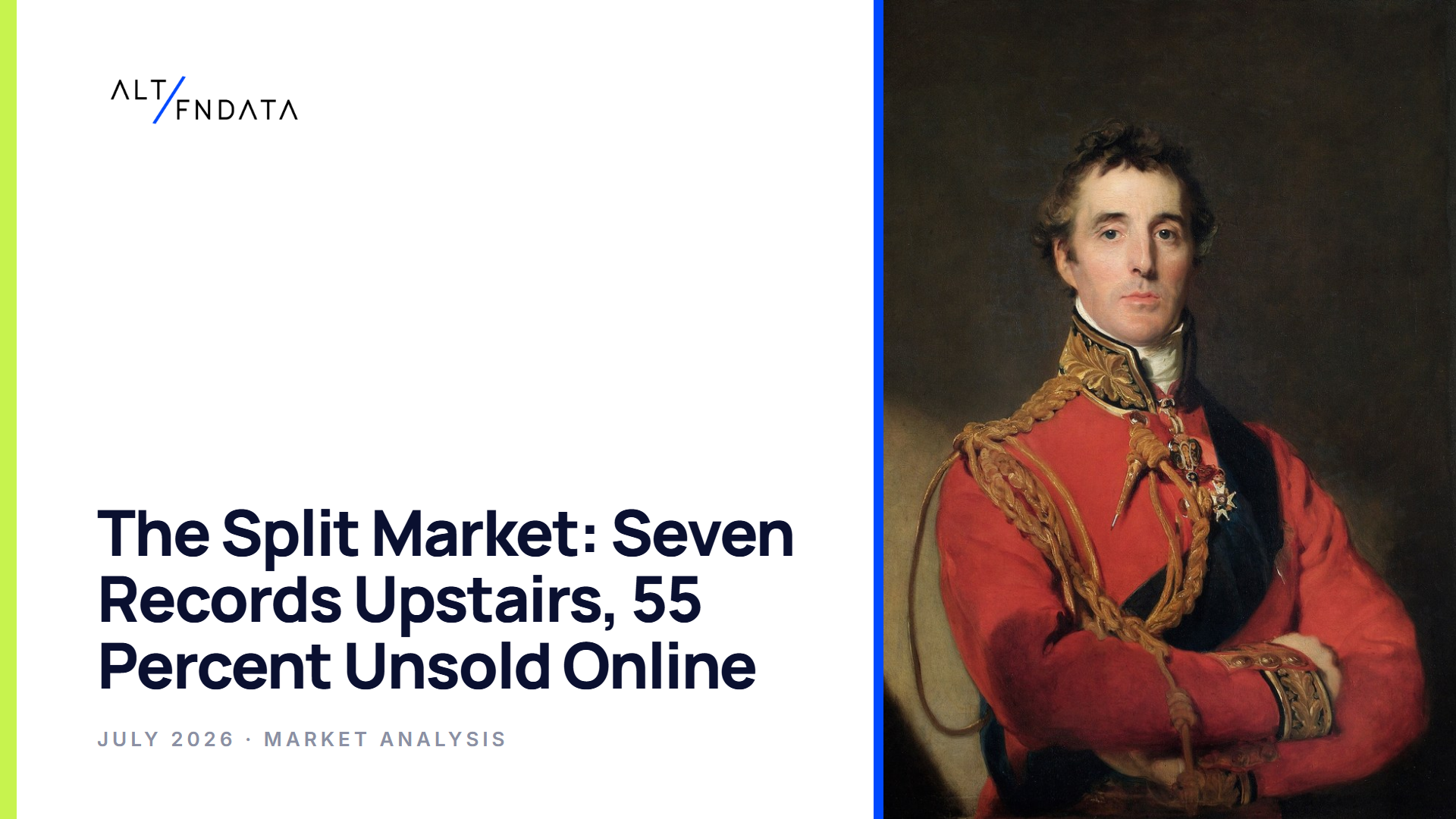
The record evening was not one trophy finding one buyer. Thomas Lawrence's portrait of the Duke of Wellington made £9.67 million, a world record for the artist, and the records ran down the price ladder: Jan van Huysum, Jan van Mieris, Girolamo da Santacroce, Adelaide Labille-Guiard, John Melhuish Strudwick. A 17th-century Dutch vanitas estimated at £80,000 to 120,000 made £431,800, more than five times its low estimate. Three buy-ins in an evening sale is the kind of figure the trade calls white glove adjacent, and it happened in Old Masters, the category the market spent a decade calling sleepy. Demand did not just show up for the headline lot; it showed up for quality at every level of the sale.
Online: the sale the market declined
The Zabludowicz online sale is the other half of the screen, and the detail that matters is what did not sell. The collection's earlier live auction, anchored by established names such as Philip Guston and Mark Bradford, had made £15.4 million. The online tranche was different material: artists collected during the emerging-art boom of the late 2000s and early 2010s, names that were once the subject of waiting lists and are now the subject of silence. More than half the lots attracted no winning bid, and the sale finished at less than a third of its low estimate. Same consignor, same house, same season. The market was not making a statement about the Zabludowicz name; it was making a statement about the material, and it made it lot by lot.
What the tier table shows
Set the two sales against our estimate data for the half and the paradox resolves. Across 18,683 sold lots with published estimates at Christie's, Sotheby's, Phillips and Bonhams in H1 2026, every price tier beat its estimates at a higher rate than a year earlier. Million-dollar lots cleared their high estimate 43.3 percent of the time, up from 31.4 in H1 2025, the largest gain of any band; the mid tiers rose seven to eight points each. Among lots that actually sell, this is the hottest estimate performance in our series, and it is hottest at the top.
| Tier (high estimate) | Above high, H1 2025 | Above high, H1 2026 | Below low, H1 2026 |
|---|---|---|---|
| $1M and above | 31.4% | 43.3% | 7.9% (from 10.0) |
| $100K to $1M | 44.9% | 53.2% | 10.0% (from 10.3) |
| $10K to $100K | 48.6% | 56.8% | 12.1% (from 14.3) |
| Under $10K | 46.5% | 56.3% | 18.8% (unchanged) |
The weakness hides in two places the sold statistics cannot reach. The first is the under-$10,000 tier's below-low share, the only one that failed to improve, stuck at 18.8 percent while every other band tightened. The second is sell-through itself: a lot that attracts no bid never enters the sold data at all. That is why a market can post record above-estimate rates and a 55 percent unsold sale in the same week without contradiction. The demand is not spread thinner; it is aimed, and what it is not aimed at simply does not transact.
What this means
For consignors, the discipline is to locate your material on the selection curve before trusting a season's headline. The same week now routinely contains both a record and a failure, which means the total tells you almost nothing; the tier table, and the sell-through of sales like yours, tell you what to expect. Provenance, rarity and condition are not premiums in this regime, they are the price of admission.
For buyers, the silence is the opportunity. The no-bid tier is where negotiation lives, and material that misses at auction increasingly trades after the sale at prices the room never saw. And for anyone reading the market from headlines: a record evening is not evidence the market is strong, any more than a half-unsold online sale is evidence it is weak. Both are evidence it is selective. The lot-level record, scored against the houses' own estimates, is where the selection shows, and it is the only place it shows early.
What to take away
One week, one regime, three disciplines:
Selectivity is the regime
Records and no-bids in the same week are not a contradiction; they are the system working. Demand concentrates on quality, rarity and provenance, and abandons everything else entirely. Expect both tails to keep getting fatter.
The tell is in what does not sell
Sold-lot statistics run hot in every tier, so the weakness only shows in sell-through and withdrawn estimates. When judging a market, or a consignment, weigh the silence: the share of material that attracts no bid at all.
Totals mislead, tiers inform
A season total blends a record evening with a half-unsold online sale and calls it one number. The tier table is the read that matters: who is beating estimates, at what price band, and which band the money has abandoned.
Seven records and a 55 percent unsold sale, in the same house, in the same week, is not a market arguing with itself. It is a market that has stopped bidding on everything and started choosing, and the choosing shows up two ways: above-estimate rates at series highs in every tier among what sells, and silence for what it declines. Read totals in this regime and you will be wrong in both directions at once. Read the tiers, the estimates and the sell-through, and the split market becomes what it actually is: the clearest information the saleroom has offered in years.
“The market is not weak or strong right now. It is selective, and the selection is brutal: what it wants, it chases through the ceiling; what it does not, it will not bid on at all.”
Methodology & about
Methodology
This is a market read. Results for Christie's Classic Week evening sales (seven world records; the Old Masters evening at £38.9 million with three buy-ins; the Lawrence at £9.67 million; the vanitas at £431,800) and for the Zabludowicz online sale (20 of 44 lots sold, £95,377 total against a £292,000 to 435,400 estimate; the earlier £15.4 million live sale) are per public reporting by Artnet News, ARTnews and Artdaily; both sales are recent enough that they are not yet reflected in our own capture. The tier table is from ALT/FNDATA's record of 13M+ auction results: sold lots with both a published low and high estimate at Christie's, Sotheby's, Phillips and Bonhams in the fine art and works of art categories, 24,286 lots in H1 2025 and 18,683 in H1 2026, tiered by high estimate in USD at nearest-date exchange rates. Realized prices generally include buyer's premium while estimates are quoted on hammer, which lifts above-estimate levels uniformly across periods; comparisons are therefore read as changes, not absolute rates. Sold-basis statistics cannot observe lots that receive no bid; sell-through claims for the two named sales are from the public per-lot results above.
ALT/FNDATA is a market-data platform tracking 13M+ auction results across 100+ houses worldwide: the neutral, cross-market record of what luxury and alternative assets actually sell for at the hammer, not asking prices.
Cite this report
Source: ALT/FNDATA, “Why the Same Week Produced Seven Art Records and a Half-Unsold Sale” (July 2026). Based on publicly reported results for Christie's Classic Week evening sales and the Zabludowicz online sale, read against estimate performance in ALT/FNDATA's record: 18,683 sold lots with published estimates at Christie's, Sotheby's, Phillips and Bonhams in H1 2026, against 24,286 in H1 2025. © 2026 ALT/FNDATA · altfndata.com/reports/split-market-2026