


Watches, art, cars, jewelry, handbags, wine and more — cleaned, USD-normalized, and searchable.
Get Started →
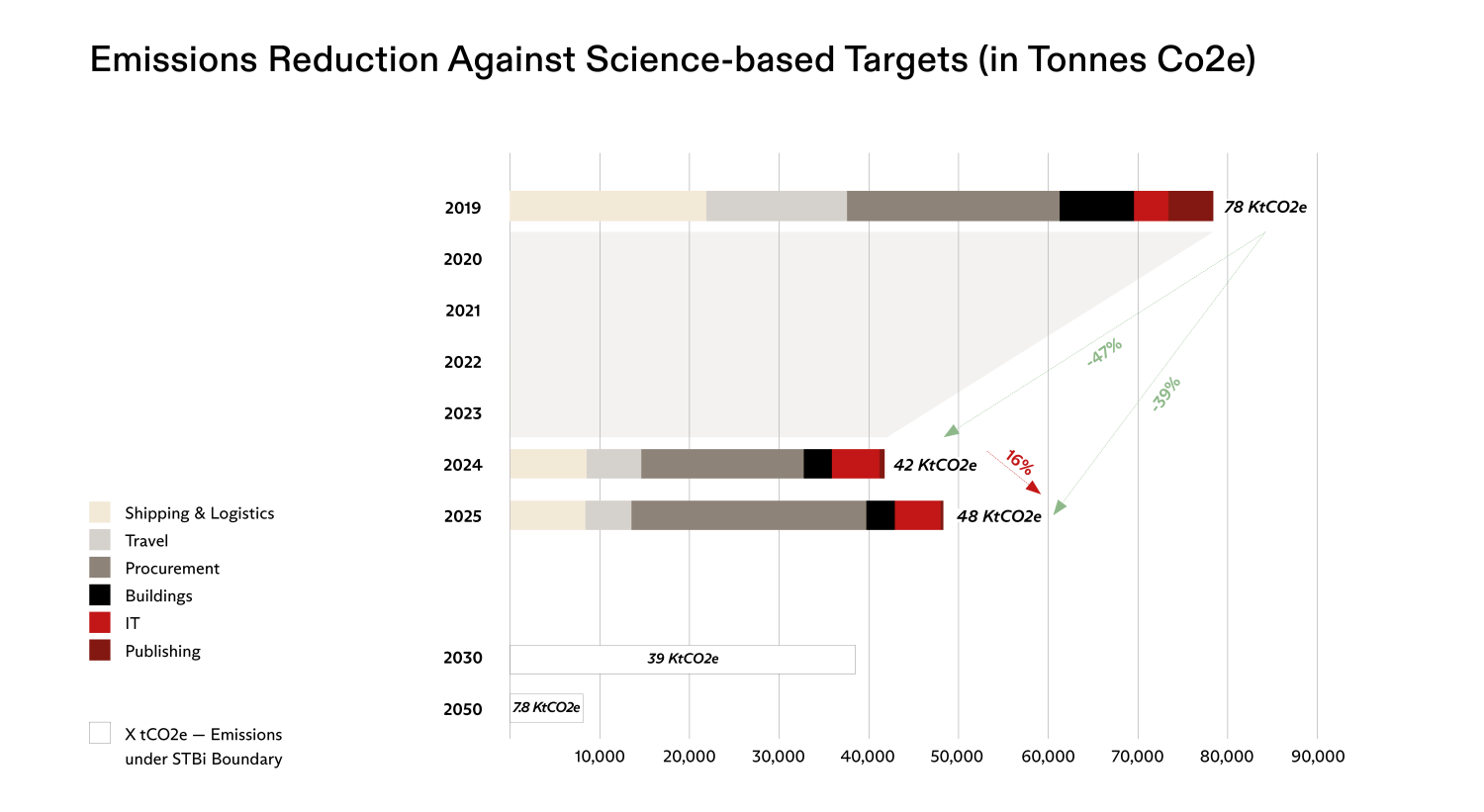
London, 30 June 2026 - In 2025, with year-on-year reductions across shipping, travel, IT and Publishing, Christie's, the world's leading art and luxury business, has reduced its carbon emissions by 39% against its 2019 baseline year. With refurbishments to its New York headquarters in Rockefeller Center, emissions related to procurement accounted for 54% of the total emissions in 2025. This three-year project includes investments in infrastructure, which will improve emissions from the building in the long term. As a result, total emissions have increased 16% year-on-year.
In 2021, Christie's was the first international auction house to commit to sustainability objectives and remains the only house committed to going beyond the regulatory minimums in pursuit of reducing its environmental footprint. The company is on track to realize its ambitions to reduce emissions by 90% by 2050, a goal validated by the SBTi.
Due to improvements in data collection and new methodologies in reporting, figures for 2019, the baseline year, and 2024, have been restated. Following the acquisition of Gooding Christie's, a recalculation of emissions was also required, which contributed 3% (1,517 tCO2e) to overall carbon emissions for 2025.
David Findlay, Christie's Head of Sustainability, commented: "We were transparent last year that, to comply with improved methodologies, we would be undertaking a restatement. This review of data recorded since 2019, has improved the accuracy of our numbers and coincided with a necessary improvement to our New York space. Across logistics, travel, energy use, waste management, packing materials and supplier engagement, we continue to integrate emissions reduction into day-to-day decision-making. These factors can influence both the pace and delivery of change, but they do not alter our direction."
In 2025, Christie's built on existing partnerships across logistics, packaging, and IT, to improve data quality, increase transparency, and support the adoption of lower-carbon practices. As an active member of the Gallery Climate Coalition (GCC), Christie's co-sponsored the GCC's first Stocktake Report, published for the launch of London's inaugural Art + Climate Week in November 2025, which was hosted at Christie's King Street.
In 2025, total emissions within Christie's reporting boundary amounted to 48,262 tCO2e.
2025 emissions summary
Buildings
3,151 tCO2e (7% of total emissions); energy used in buildings, refrigerants, waste, water, paper, and employee commuting.
In 2025, building emissions increased by 4% from 2024 but decreased by 62% from the base year 2019. The increase was largely due to off-site sales at Gooding Christie's.
IT
5,128 tCO2e (11% of total emissions); IT procurement, data centers, post and telecommunications, e-waste, and on-blockchain activities.
In 2025, IT emissions decreased by 5% from 2024. They were 33% above 2019 levels given ongoing investment in digital capabilities to support business growth and transformation.
Shipping
8,272 tCO2e (17% of total emissions); inbound and outbound freight, exhibition tours, other internal logistics and storage, and packaging.
In 2025, shipping emissions decreased by 1% and by 62% from the 2019 base year.
Business travel
5,157 tCO2e (11% of total emissions).
Last year travel emissions decreased by 16% and were down by 67% from 2019. The new travel policy from last year and behavior change alongside a reduction in the emissions intensity of air travel, has contributed to the year-on-year decrease.
Procurement
26,237 tCO2e (54% of total emissions); purchased goods and services and capital goods.
This was a new category introduced last year to align reporting with new SBTi requirements. The emissions increase in 2025 was primarily driven by the renovation of Rockefeller Center in New York. This project, which will conclude after 2027, was a necessary investment for the future and will increase efficiency as updates include:
Estimating emissions for purchased goods and services remains complex as data comes from suppliers. Emissions within direct operational control, Scopes 1 and 2, accounted for 2% of total emissions in 2025. Scope 3 indirect emissions (much of which sits within Procurement) continue to represent the largest share of Christie's total carbon footprint but remain 35% below 2019 levels.
Publishing
299 tCO2e (less than 1% of total emissions); production and distribution of printed material.
(Press Release)