

Watches, art, cars, jewelry, handbags, wine and more — cleaned, USD-normalized, and searchable.
Get Started →
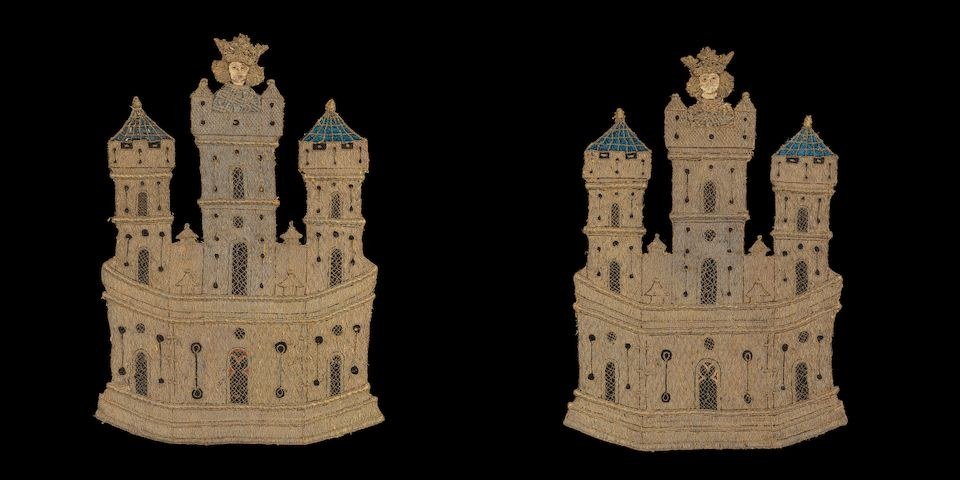
A pair of late medieval royal heraldic embroideries, likely linked to the Kingdom of Castile, is offered by Bonhams with an estimate of £200,000 to 300,000. Radiocarbon dating and silver testing date the embroideries to before 1600, and combined with technical and art-historical evidence they are thought to date from about 1460 to 1520.
During the 15th century a number of weaving centres operated in Spain, including several Islamic textile workshops, the most famous of which were in Al-Andalus, at Almeria. These centres had supplied the royal court of Castile with sumptuous textiles since the 13th century and were known for their manipulation of metal thread on coloured silks. During the Nasrid period, from the mid-13th to the late 15th century, new techniques were introduced, including raised padding, which created greater depth and a sense of three dimensionality.
The earliest record of Castilian arms dates from the reign of Alfonso VIII of Castile, with the three-tiered castle appearing on the great seal, on a number of coins, and on Alfonso’s tomb at Santa Maria la Real de Las Huelgas, near Burgos. Coins from the period offer rare examples of royal heads paired with the three-towered castle of Castile, including one featuring the head of John II, father of Henry IV. The banding at the collar of that figure resembles the clothing of the crowned figure emerging from the tower in the embroideries.
The two heads depicted may represent two different kings rather than the same monarch, one possibly Henry IV (1425-1474) and the other his father John II (1405-1454). The pairing could be intentional given their rule over the kingdoms of Castile and Leon. The great-grandfather of Henry IV was John of Gaunt, Duke of Lancaster (1340-1399), fourth son of Edward III, who had sought the Castilian throne in the name of his wife Constance of Castile. When Catherine of Lancaster, daughter of John of Gaunt, married Henry III of Spain, two rival claims to the throne were united, and their descendants John II and Henry IV became the undisputed kings of Castile and Leon.
If the figures are indeed Castilian kings, or one king depicted twice, this would support the suggestion that the embroideries served a ceremonial function, possibly applied to a coffin shroud or a banner used at an important state event.
(Press Release)