

Watches, art, cars, jewelry, handbags, wine and more — cleaned, USD-normalized, and searchable.
Get Started →
London, 14 May 2026 - Bonhams presents its celebrated Asian Art Week in London this May, a wide-ranging program of live and online auctions bringing together exceptional works spanning China, Japan, Tibet, and other regions, spanning over two-thousand years. Across two live sales, one at New Bond Street and one at Knightsbridge, complemented by four online auctions, the week offers collectors a rare opportunity to engage with works of outstanding artistic and historical significance.
Asian Art Week runs from 8 to 19 May 2026, with live auctions taking place on 11 to 12 May at Knightsbridge and 14 May at New Bond Street.
Asaph Hyman, Global Head, Chinese Art, commented: "Asian Art Week in London brings together works of exceptional rarity, scholarship and visual impact, from imperially commissioned historic pieces to objects of remarkable ingenuity. Highlights such as the Album of Tributary Peoples underscore the intellectual ambition of Qing Court art, while the breadth of the sales reflects the enduring global appetite for Asian works that combine historical importance with outstanding craftsmanship, not least Prime Minister Margaret Thatcher's own jadeite seal made on the occasion of her visit to Beijing in 1982."
ASIAN ART
11-12 May 2026, live auction at Knightsbridge
Heading the sale is a fine moriage cloisonné enamel 'Bird and Persimmon' vase by the workshop of Ando Jubei (1876 to 1953) of Nagoya, dated to the fourth year of Shōwa (1929) and estimated at £12,000 to 15,000. Among the most influential Japanese cloisonné artists of the late Meiji, Taishō and early Shōwa periods, Ando Jubei was renowned for the technical innovation of his workshop, particularly in the use of moriage, or raised enamel, as well as delicately shaded transparent enamels that allow for subtle gradations of color, carefully demonstrated in the present work.
Also featured is Silk Production, attributed to the Chinese School, circa 1800, and estimated at £3,000 to 5,000. Dating to the turn of the 19th century, the work offers an engaging depiction of traditional silk manufacture, combining refined brushwork with documentary interest and reflecting the period's fascination with artisanal processes and everyday life.
FINE CHINESE ART
14 May 2026, live auction at New Bond Street
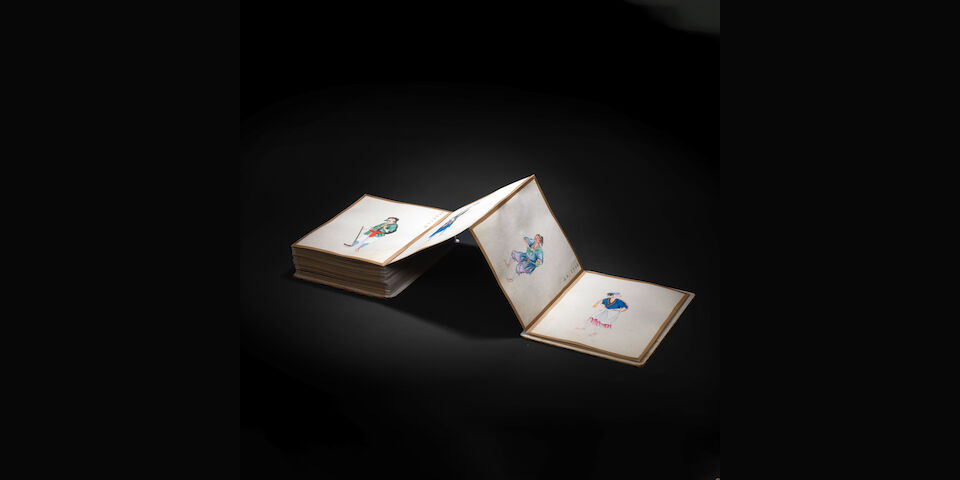
Leading the sale is A Very Rare Album of Tributary Peoples (Zhigong Tu) from the Qianlong period (1736-1795), estimated at £80,000 to 120,000. Concertina-bound with silk-wrapped boards, the album comprises forty-four painted leaves in ink and color on paper, depicting figures from diverse ethnic groups and nations, together with forty-nine leaves of related calligraphy. The work is associated with the monumental imperial project Qing Imperial Illustrations of Tributary Peoples (Huangqing zhigong tu), completed in 1761, which documented the history, geography, costume, customs and diplomatic relationships of 27 countries and 274 ethnic groups, and may represent one of the earliest preparatory versions of this undertaking.
Also offered is Qi Baishi (1863 to 1957), Fish and Crabs, estimated at £30,000 to 50,000, in which the artist masterfully balances sparse and dense compositional elements, using the full range of ink tonalities, from burnt to clear, to create contrast, spatial depth and a vivid sense of pictorial rhythm.
A rare and historically significant jadeite 'Buddhist lion' seal, presented to the Right Honourable Margaret Thatcher, Prime Minister of the United Kingdom, commemorates her landmark official visit to the People's Republic of China, 22 to 26 September 1982. Offered with exceptional provenance and political resonance, the lot is estimated at £3,000 to 5,000.
A LIFE IN CERAMICS: THE PETER AND MARY WHITE COLLECTION OF CHINESE ART, PART III
8-15 May 2026, Online auction via New Bond Street
- ALL LOTS OFFERED AT NO RESERVE -
Highlights include a fine doucai 'medallion' bowl, bearing a Qianlong seal mark of the period (1736-1795). Elegantly decorated in the delicate doucai palette, the bowl exemplifies the technical refinement and aesthetic balance associated with imperial wares of the Qianlong reign. It is estimated at £10,000 to 15,000.
Additionally, there will be a rare blue and white 'cat' night light from the Chongzhen period (1628-1644), estimated at £8,000 to 12,000. Such objects are described in a letter of 1712 by the Jesuit missionary Père d'Entrecolles, who recorded their use as night lights with a small lamp placed inside so that the flame illuminated the eyes. This ingenious device was believed to deter mice after dark, combining whimsical charm with practical function.
CHINESE AND JAPANESE ART FROM RICHARD VANDEKAR LTD:
A THIRD-GENERATION LONDON DEALER
8 to 18 May 2026, Online auction via Knightsbridge
- ALL LOTS OFFERED AT NO RESERVE -
A highlight of the sale is a fine pair of famille rose ruby back semi eggshell 'Lady and Boy' dishes, dating to the Yongzheng period (1723-1735), and estimated at £20,000 to 30,000. Around 1720, the development of a new opaque overglaze palette in China, most notably the introduction of an opaque white enamel, greatly expanded the chromatic possibilities available to potters. Some of the most technically accomplished fencai wares were produced during the Yongzheng reign, and the present dishes exemplify this refinement. Crafted from eggshell thin porcelain, they belong to the group known as ruby back wares, distinguished by their distinctive pink toned exterior.
Also featured is a pair of Shibayama inlaid gold lacquer trays by Komin, dating to the Meiji period (1867-1912), and estimated at £8,000 to 12,000. Combining gold lacquer with finely detailed Shibayama inlay, the trays demonstrate the exceptional craftsmanship and decorative sophistication associated with late 19th century Japanese luxury arts, reflecting the Meiji era's fusion of traditional techniques with an increasingly international aesthetic.
THE TRUDY AND JOHN NEVILLE COHEN COLLECTION OF CHINESE SNUFF BOTTLES AND JADE CARVINGS
8-18 May 2026, Online auction via New Bond Street
Highlights include a finely carved white to pale green jade figure of an elephant and boy, dating from the Qianlong to Jiaqing period (1736-1820), exemplifies the refined workmanship and auspicious symbolism favoured at the Qing court. The piece is offered with an estimate of £5,000 to 8,000.
An elegant imperial yellow glass 'dragons' snuff bottle, 18th/19th century, reflects the prestige associated with imperial yellow, a color traditionally reserved for the emperor. The bottle is estimated at £2,600 to 3,500.
A rare cloisonné enamel 'bats' snuff bottle and stopper, bearing a Qianlong four character mark and of the period (1736-1795). The vibrant enamels and confident design highlight the sophistication of imperial cloisonné wares. It is estimated at £2,600 to 3,900.
Completing the selection is a charming chalcedony agate 'monkey and peach' snuff bottle, 18th/19th century. The estimate for this lot is £1,500 to 2,000.
COLLECTORS TREASURES: ASIAN ART ONLINE
8-19 May 2026, Online auction via Knightsbridge
Highlights include a moulded and reticulated fahua 'Eight Immortals' jar (guan), dating to the Ming dynasty, and estimated at £3,000 to 5,000. The depiction of the Eight Immortals, a popular Daoist subject symbolising longevity and virtue, reflects the period's interest in both narrative decoration and technical experimentation.
Also included is an Arita Kakiemon style 'Auspicious Fruits' dish, dating to the Enpō period (1673 to 1681), and estimated at £2,500 to 3,500. The use of both front and reverse decoration highlights the sophistication of early Arita porcelain.
(Press Release)